Guests do not follow your internal process
A guest may start on Google, open Maps, read reviews, visit the website, send a WhatsApp message, and follow up by email.
From the guest’s perspective, that is normal.
From the dive center’s perspective, it can become messy fast.
The same person can appear in different channels with different pieces of information. One message has the date. Another has the certification level. A third asks about equipment rental.
The channel is not the only problem
Many operators ask whether they should focus on WhatsApp, email, forms, or booking widgets.
The better question is: how does the team keep context across all channels?
Without a shared workflow, leads can get stuck:
- a WhatsApp reply is not logged
- an email has missing details
- a form submission lacks certification level
- a booking tool note is not visible to the person answering
One front desk workflow reduces leakage
A shared front desk workflow should:
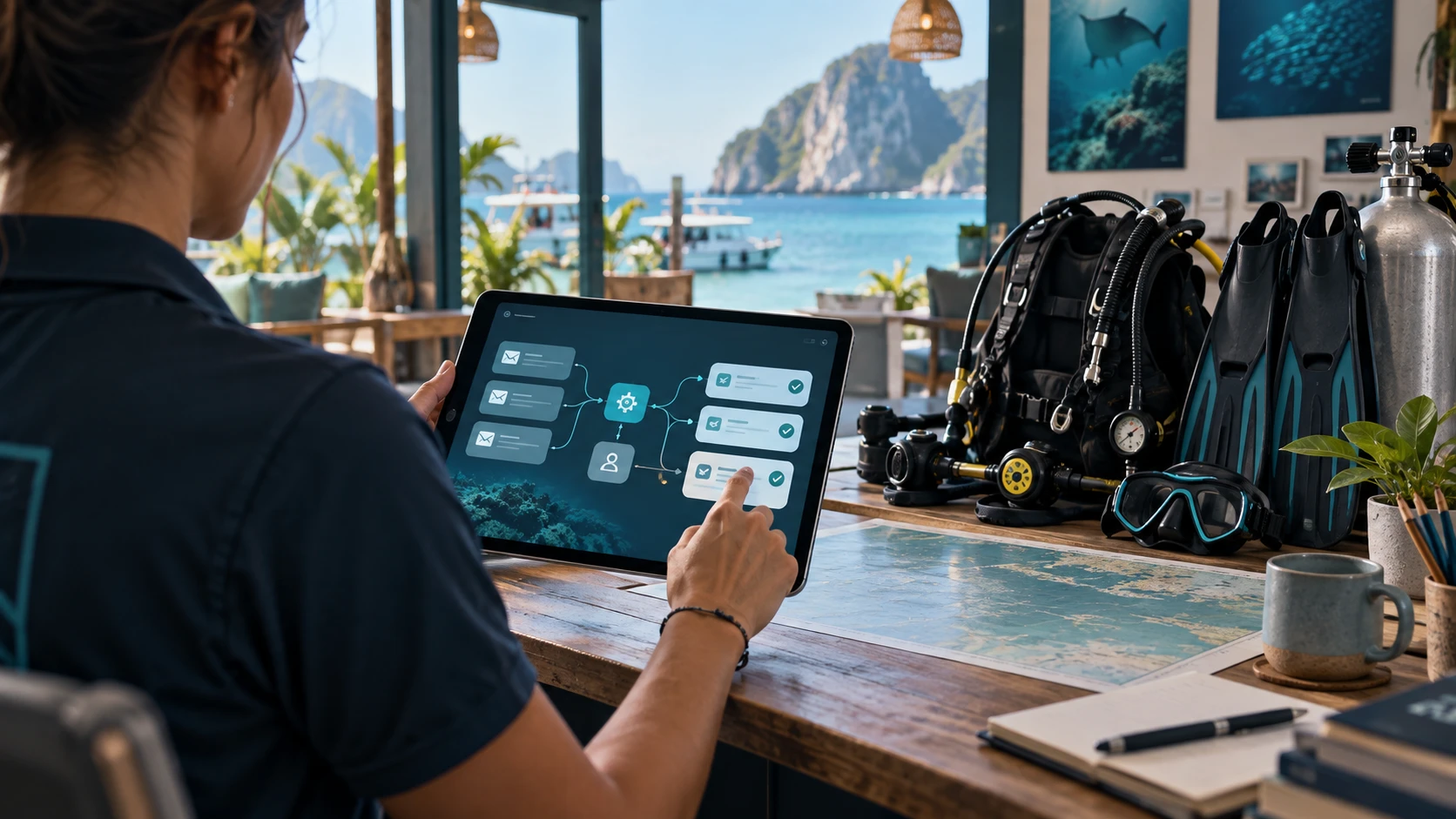
- capture the incoming message
- normalize the channel
- identify the guest and intent
- extract useful details
- show missing information
- prepare a draft reply
- keep a human review step
The team still uses the channel that makes sense. The difference is that the work behind the reply becomes structured.
Why this matters for conversion
Guests often contact more than one dive center.
If your team answers with a clear next step while another center sends a generic or delayed reply, your center feels easier to book.
That does not mean rushing safety or making promises too early. It means giving the guest a professional response that moves the conversation forward.
DiveOS is built for channel reality
DiveOS treats email and WhatsApp as sources of the same operational problem: guest enquiries need structure before they become bookings.
The inquiry operations prepares that structure. The team keeps control.
Answer Block
Dive centers need one front desk workflow across WhatsApp and email because guests do not care which channel is operationally convenient. They care whether the reply is fast, clear, and useful.
Problem from a dive school perspective
Messages arrive while staff are teaching, guiding, filling tanks, or checking equipment. Some enquiries sit in WhatsApp, some in email, some in contact forms.
Practical example
A guest asks by email about an open water course, then later sends a WhatsApp message about pickup. Without a shared view, the team may answer twice, miss context, or forget a required detail.
Concrete actions
- Define one owner for incoming enquiries.
- Collect key booking details consistently.
- Use reply templates only as a starting point.
- Track whether a lead needs follow-up.
- Let DiveOS prepare context and drafts for human review.
Checklist
- WhatsApp and email are checked daily.
- Enquiries have status, owner, and next step.
- Follow-up questions are consistent.
- Guest details are not scattered across channels.
- The team approves every outbound answer.
FAQ
The structured FAQ for this draft is defined in the frontmatter. Keep body answers and frontmatter answers aligned before publishing.
CTA
Want to simplify WhatsApp and email handling? Book a DiveOS Demo.
FAQ
Which channel should a dive center prioritize?
The best channel depends on the guest and destination. The stronger move is to create one workflow for all important enquiry channels.
How can a dive center handle both WhatsApp and email?
A shared intake process can bring email and WhatsApp context together before the team responds.