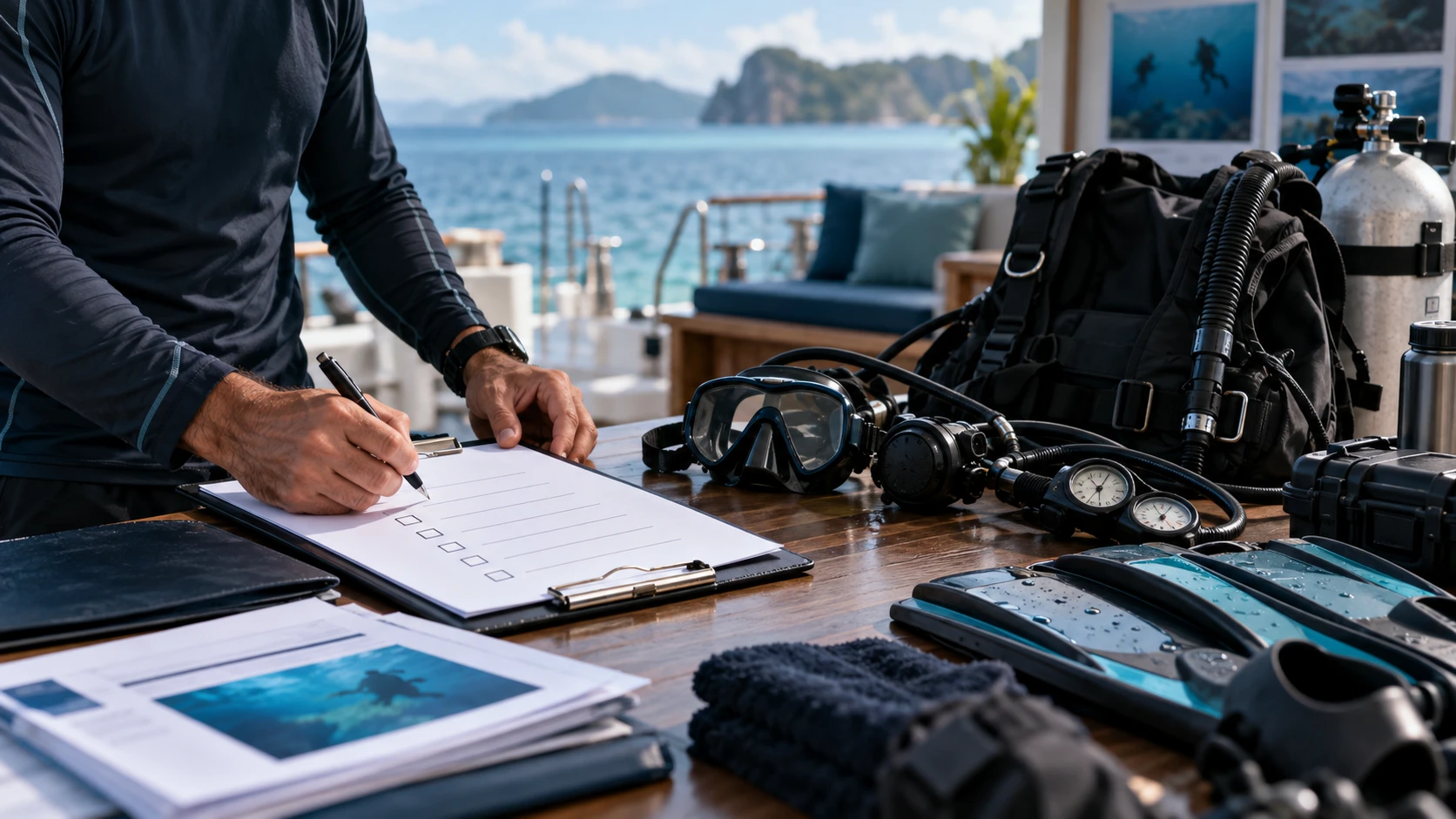
A dive operator website cannot predict conditions, confirm a guest’s suitability, or replace a conversation with qualified staff. It can, however, make the decision process clearer before a guest enquires. That matters when a visitor is comparing trips, deciding whether a dive may suit their experience, or trying to understand what happens if conditions change.
A useful dive operator safety policy website does not make blanket promises. Instead, it explains what information the operator needs, which factors may affect a trip, who makes operational decisions, and when a guest should contact the team directly. This gives prospective guests a more realistic basis for an enquiry while preserving the operator’s discretion.
Experience basis: The article is an evidence-led editorial guide based on DAN and PADI safety guidance, not a claim of DiveOS operating a dive centre or making site-specific safety decisions.
Why pre-trip website information is an operational tool
Trip pages are often treated as promotional copy: destination, departure time, marine-life highlights and a booking button. For diving, clear operational information is also part of expectation-setting. Guests may arrive with different experience levels, equipment familiarity, physical circumstances and assumptions about a site.
DAN’s guidance for dive operators notes that site risk can be affected by factors including depth, temperature, currents, bottom topography, marine life and visibility. Its guidance also points to managing customer expectations before the trip. Read the relevant DAN dive-trip guidance before adapting any wording for an individual operation.
On a website, this does not require publishing an exhaustive risk assessment or giving a universal rule for every visitor. It means identifying the questions that matter before a guest assumes a trip is confirmed or appropriate. For example, a trip page can state that routes, sites, timings and participation are subject to assessment by the operator and relevant staff.
The aim is clarity, not deterrence. A guest who understands that a trip may involve suitability questions is better positioned to share useful information in an enquiry. A guest who needs a direct conversation can be guided to one before relying on general website copy.
A decision matrix for guest-facing wording
Build website wording around the real decisions your team may need to make. The matrix below is a content-planning device, not an operational policy or a substitute for professional, legal or safety advice.
| Operational question | Useful website wording | Next step for the guest |
|---|---|---|
| Does the guest appear suited to the planned activity? | “Please share your certification, recent diving experience and any trip-specific questions when you enquire. Our team will review the information relevant to the planned activity.” | Ask for a direct enquiry rather than implying automatic eligibility. |
| Could conditions affect the planned site or itinerary? | “Dive sites, routes and timings may be adjusted in response to conditions and operational assessment.” | Invite guests to ask what information is currently available, without promising a forecast or outcome. |
| Could a trip be changed or not proceed as originally planned? | “The planned itinerary is an outline and may change when the team considers an alternative or cancellation appropriate.” | Explain the operator’s process separately if local policy requires it. |
| Could staff decline participation? | “Participation remains subject to assessment by the operator and relevant dive professionals.” | Provide a contact route for questions before booking. |
| Does a query need individual review? | “If you are unsure whether this trip is right for you, contact our team before booking so we can discuss the available information.” | Route the enquiry to staff rather than trying to resolve it through generic FAQ text. |
This structure makes an important distinction: the website describes how decisions are approached; it does not announce the result of a future assessment. That distinction helps avoid phrases such as “safe for all levels,” “guaranteed conditions,” “always suitable,” or “no cancellations.”
Write clearly without making guarantees
Good wording is specific about process and careful about outcomes. Start with the information a guest can provide, the variables the operator may consider, and the point at which direct staff review is needed.
Use conditional, plain-language verbs: “may change,” “will be assessed,” “please contact us,” and “remains subject to operational decision.” Avoid vague reassurance that could be read as a promise. “We prioritise safety” may express intent, but it tells guests little about what happens when a site, itinerary or participation decision needs review.
It is also important not to present discretion as arbitrary. Explain the reason for it at a general level: conditions and individual circumstances can vary, and the team may need current information before confirming what is appropriate. PADI’s discussion of when to call off a dive supports the principle that ending a dive for safety or equipment reasons is legitimate. That does not establish a universal policy for your operation; it supports clear, respectful communication about changing plans.
Similarly, DAN discusses a dive professional’s right to refuse service where risk may affect a client, staff or other divers. Review the full DAN right-of-refusal guidance and obtain appropriate local advice before publishing policy language. Your copy should reflect your own documented processes, jurisdiction and operational responsibilities.
Place the right information where guests need it
Do not bury all trip-decision information in a single policy page. Place a short, consistent explanation on the pages where guests form expectations, then offer a clear route to staff review.
- Trip pages: Explain that the site or itinerary may be adjusted and identify the trip-specific information guests should share.
- Booking pages: State that a booking or enquiry does not override the operator’s assessment process. Keep the wording concise and link to fuller information where appropriate.
- FAQs: Answer practical questions about changing plans, suitability discussions and how to contact the team. Do not turn an FAQ into medical, legal or site-specific advice.
- Contact forms: Include optional, relevant fields that help staff understand the enquiry, but avoid asking visitors to self-certify an outcome through simplistic checkboxes.
Consistency matters more than volume. If a trip page says the itinerary may change but a booking page promises a fixed experience, guests receive conflicting signals. Review the complete path from search result to enquiry and make sure each page describes the same decision boundary.
A practical review checklist
Before publishing or revising safety and trip-decision copy, ask:
- Does the page explain what may be assessed without claiming that a future guest is suitable?
- Does it acknowledge that conditions, sites, routes or timings may change without predicting weather or availability?
- Does it preserve the operator’s and relevant staff’s discretion?
- Does it direct uncertain guests to a real person or appropriate enquiry route?
- Does it match your documented policies, insurer requirements, training-agency requirements, local conditions and jurisdiction?
- Have you removed guarantees, broad safety promises and unsupported outcome statements?
For operators, clearer information is not a replacement for operational judgment. It is a way to make the website more honest about where general information ends and individual review begins.
Review the enquiry path before guests rely on it
If your trip, booking and FAQ pages describe safety-related decisions inconsistently, start by mapping the wording against the decisions your team actually needs to make. Then identify where a visitor should be invited to contact staff rather than draw conclusions from generic copy.
Request a Dive Growth Audit to review whether your safety and trip-decision information is clear before guests enquire.
Limitations
This is not legal, medical or operational safety advice. Operators must adapt wording to their jurisdiction, insurer, training-agency requirements, local conditions and own policies. The sources support discretion and expectation-setting, not guarantees about safety, weather, availability, suitability or trip outcomes. The primary keyword may have limited natural search demand despite a credible underlying operator need.