Multilingual SEO for Dive Schools: An Implementation Plan
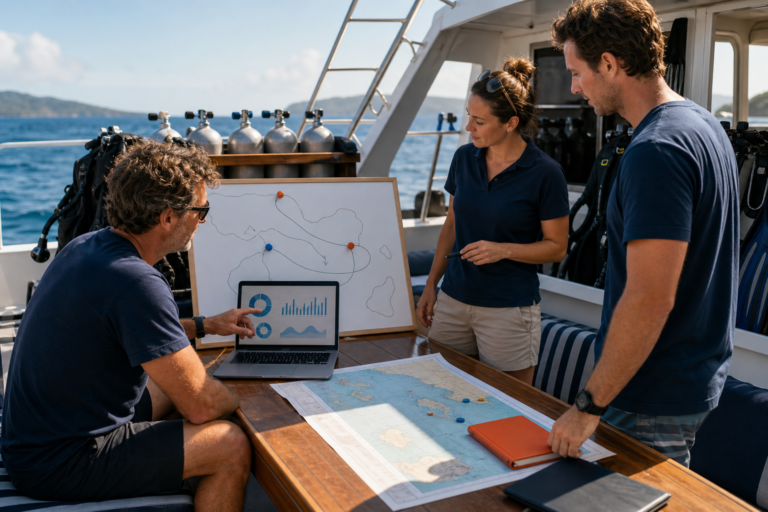
AI-generated image: The featured image was generated with artificial intelligence and is used for illustrative purposes.
Multilingual SEO helps a dive school serve people who search, compare and enquire in different languages. SEO means improving pages so search engines can understand and show them for relevant searches. However, a translated page alone rarely creates a useful booking journey.
Before work begins, owners need to decide which language market deserves attention first. They also need to check whether the course, diving trip, price information, form, and follow-up can support that visitor. This guide gives you a practical implementation plan without assuming that every language or country will produce the same result.
Start with language-specific intent
Language-specific intent is the need behind a search in a particular language and market. In a dive school, that need may combine a language, destination, service, season, and decision stage.
For example, someone searching in German for an Open Water course may need different information from someone searching in English for a local guided dive. One visitor may compare course dates, requirements, and prices. Another may want meeting details, equipment information, and immediate availability.
Therefore, do not begin with a list of languages. Instead, begin with the customer journey you can genuinely support. Record the offers you sell, the markets you can serve, and the languages your team can handle after an enquiry arrives.
Next, separate discovery pages from decision pages. A discovery page answers an early question, such as what diving is available in a destination. By contrast, a decision page helps a visitor act, for example by showing course dates, prerequisites, inclusions, and a clear enquiry route.
Choose the first language market with evidence
Use your own evidence before commissioning a large translation project. Search Console can show search performance by query, page, and country. It also reports clicks, impressions, click-through rate, and average position. Consequently, review these signals together rather than in isolation.
First, look for recurring enquiries in another language. Then check whether your staff can answer those enquiries clearly and promptly. Also review whether the relevant service is available during the visitor’s likely travel period.
For each possible market, create a simple scorecard. Include current enquiries, Search Console signals, course or trip availability, language capability, payment and booking support, and the work needed to maintain the pages. Rather than relying on a total score alone, give each item a short written reason.
For example, a market may show interest but still be a poor first choice if no one can handle pre-course questions in that language. Likewise, a strong existing enquiry pattern may justify a focused rollout even when search data is limited.
GA4 can provide country and device-language dimensions. However, treat device language as a supporting clue, not proof of search language or commercial intent. Enquiry records, sales conversations, and booking data give necessary context.
Map the complete localized journey
Choose one language-market combination and map the full route from search to enquiry. Otherwise, you may translate a blog post while leaving the booking path in another language.
At a minimum, check the main service page, course or trip page, destination details, prices or price context, prerequisites, FAQs, enquiry form, confirmation message, and follow-up process. Also decide who owns updates when schedules, availability, or requirements change.
Use natural wording for each market. German and Spanish versions need independent editorial work, not literal automatic translation. In particular, diving terms, local place names, qualifications, currency expectations, and questions about safety or logistics may need different phrasing and examples.
Each localized landing page should answer one clear need. Match the page to the visitor’s decision. For a course page, provide practical course information. For a day-trip page, provide location, timing, inclusions, and next steps. A resort partnership page may need a different structure again.
Also test every action a visitor can take. Submit a test enquiry, check the confirmation email, and review the route to your booking system. If the page promises a language your team cannot support, change the promise or delay the rollout.
For wider page architecture and search-intent work, see SEO for dive centers. If the rollout requires changes to templates, forms, or booking paths, review the related website conversion work.
Set up the technical foundation
Use a stable, distinct URL for each language version. Google recommends separate URLs for localized content and supports hreflang annotations through HTML, HTTP headers, or sitemaps. Hreflang is a signal that helps Google understand alternate language or regional versions; it is not a ranking guarantee.
Next, keep one clear multilingual architecture. Your chosen WordPress setup must define URL structure, translation relationships, canonical handling, language switchers, and sitemap output. Because plugin behaviour varies, verify these details in the documentation for the tool you actually use.
Google says it primarily uses visible content to determine a page’s language. Therefore, do not rely on an HTML language attribute, a country URL, or hreflang alone. Complete, consistent language content is still necessary on the page itself.
For each translated page, check the following:
- The main visible content is fully and naturally localized.
- Each page references itself and its appropriate alternates.
- Alternate references work both ways and use complete URLs.
- Language and regional codes are valid for the intended audience.
- Titles, descriptions, navigation labels, forms, and error messages do not switch languages unexpectedly.
- Internal links lead visitors to the matching language version where one exists.
Properly translated localized pages are not automatically a duplicate-content problem. By comparison, untranslated or mostly copied pages are the real concern. Finally, avoid automatic language redirects that stop visitors from choosing their preferred version.
Review content before indexing
Ask a qualified human reviewer to check every decision page before it goes live. That reviewer should understand the target language and the diving offer. They should also compare the page against the real operating process.
Check terminology carefully. Course names, certification requirements, equipment inclusions, medical guidance, cancellation terms, and pickup arrangements must match your current operation. Where needed, legal or medical wording may require specialist review before use.
Next, inspect the page on mobile. Many visitors will compare courses or trips from a phone. As a result, the form, contact route, price context, dates, and next step should remain easy to find.
Use the same review to confirm that each language page is useful on its own. A visitor should not need to switch languages to understand the offer, ask a question, or complete the first booking step.
Measure the rollout and decide what happens next
Launch one priority area first, such as a course family or a destination service. Record the launch date, affected URLs, owner, technical checks, and the evidence behind the decision. This creates a useful baseline for later review.
Then monitor Search Console by page, query, and country. Also review localized landing-page activity, enquiry language, enquiry quality, booking conversations, and confirmed outcomes in the systems you already use. Since consent settings and disconnected booking tools can limit what you can connect, document those limits.
Set a review date before launch. At that review, decide whether to improve the pages, expand the language scope, pause further work, or correct technical issues. Crucially, do not treat impressions or a form submission as proof of commercial success.
Finally, a measured rollout is usually easier to maintain than a rushed multilingual site. For strategic support, see DiveOS’s multilingual growth strategy and growth marketing for dive centers and schools.
A practical owner checklist
- First, choose one language-market and one service priority.
- Next, confirm that demand signals, operational capacity, and follow-up capability support the choice.
- Then map every customer step from search result to enquiry response.
- Also build complete localized pages rather than literal translations.
- Afterward, verify URL, hreflang, canonical, sitemap, and language-switcher behaviour for your own setup.
- Finally, test the form and booking path in the target language.
- At the fixed review point, measure evidence after launch and decide the next step.